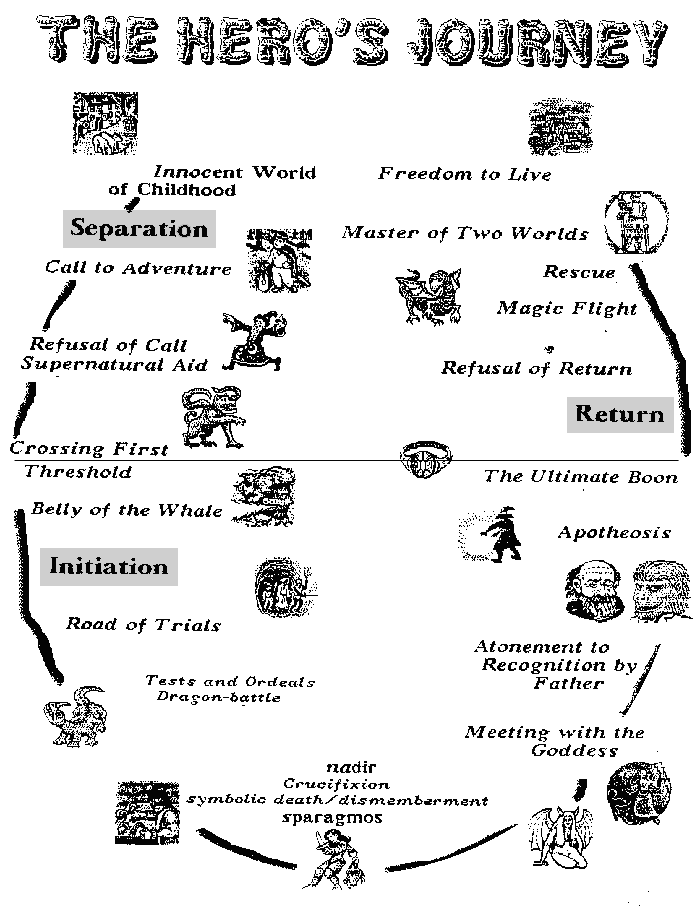
The Hero's Journey is an amazing little thing. It's a very well-used skeleton for a story. So well-used, in fact, that you can look at almost every story ever written and see the Hero's Journey in it.
Not only is it known that most of literature is based on the Hero's Journey (both strictly and loosely), I have found that real life events can also be based off it. Here is an outline of the Hero's Journey that is more detailed than the picture above, and also how I have placed it around a specific event in my life - my first dating experience.
A. Departure
My notes will be made in italics, see how this works? Anyways, the Hero's Journey can be split into three bigger sections, Departure is the first.
1.The Call to Adventure
The call to adventure is the point in a person's life when they are first given notice that everything is going to change, whether they know it or not.
A young man began to show interest in me, in the form of writing many many notes to me.
2.Refusal of the Call
Often when the call is given, the future hero refuses to heed it. This may be from a sense of duty or obligation, fear, insecurity, a sense of inadequacy, or any of a range of reasons that work to hold the person in his or her current circumstances.
I, being an insecure pre-teen girl at the time, am nervous and basically avoid said young man.
3.Supernatural Aid
Once the hero has committed to the quest, consciously or unconsciously, his or her guide and magical helper appears, or becomes known.
Several of my friends begin to convince me that yes, I should date this young man. Being an impressionable young girl, I agree.
4.The Crossing of the First Threshold
This is the point where the person actually crosses into the field of adventure, leaving the known limits of his or her world and venturing into an unknown and dangerous realm where the rules and limits are not known.
I decide to agree to date this young man.
5.The Belly of the Whale
The belly of the whale represents the final separation from the hero's known world and self. It is sometimes described as the person's lowest point, but it is actually the point when the person is between or transitioning between worlds and selves. The separation has been made, or is being made, or being fully recognized between the old world and old self and the potential for a new world/self. The experiences that will shape the new world and self will begin shortly, or may be beginning with this experience which is often symbolized by something dark, unknown and frightening. By entering this stage, the person shows their willingness to undergo a metamorphosis, to die to him or herself.
I start dating this boy, which means a lot of big things in a pre-teen's life. The scary acts - scary to a nervous pre-teen girl - such as holding hands, dates, and phone calls begin to occur.
B. Inititation
1.The Road of Trials
The road of trials is a series of tests, tasks, or ordeals that the person must undergo to begin the transformation. Often the person fails one or more of these tests, which often occur in threes.
I must inform my parents of this relationship, I must aknowledge this young man in public as my boyfriend, and must become a girlfriend toward this young man. Several of which I did a very pathetic job at.
2.The Meeting with the Goddess
The meeting with the goddess represents the point in the adventure when the person experiences a love that has the power and significance of the all-powerful, all encompassing, unconditional love that a fortunate infant may experience with his or her mother. It is also known as the "hieros gamos", or sacred marriage, the union of opposites, and may take place entirely within the person. In other words, the person begins to see him or herself in a non-dualistic way. This is a very important step in the process and is often represented by the person finding the other person that he or she loves most completely. Although Campbell symbolizes this step as a meeting with a goddess, unconditional love and /or self unification does not have to be represented by a woman.
This one I have a difficult time applying. Perhaps it is the acceptance felt in that first real boyfriend/girlfriend relationship.
3.Woman as the Temptress
At one level, this step is about those temptations that may lead the hero to abandon or stray from his or her quest, which as with the Meeting with the Goddess does not necessarily have to be represented by a woman. For Campbell, however, this step is about the revulsion that the usually male hero may feel about his own fleshy/earthy nature, and the subsequent attachment or projection of that revulsion to women. Woman is a metaphor for the physical or material temptations of life, since the hero-knight was often tempted by lust from his spiritual journey.
Rather loosely, I'd say this is the point where my one very innocent friend starts to discourage me from dating this young man. This young man is also beginning to freak me out because he is becoming far more attached to me than I to him.
4.Atonement with the Father
In this step the person must confront and be initiated by whatever holds the ultimate power in his or her life. In many myths and stories this is the father, or a father figure who has life and death power. This is the center point of the journey. All the previous steps have been moving in to this place, all that follow will move out from it. Although this step is most frequently symbolized by an encounter with a male entity, it does not have to be a male; just someone or thing with incredible power. For the transformation to take place, the person as he or she has been must be "killed" so that the new self can come into being. Sometime this killing is literal, and the earthly journey for that character is either over or moves into a different realm.
Yes, this relationship is freaking me out. Plus, the young man went an entire summer without calling. Rude, much? I think it's time to break up.
5.Apotheosis
To apotheosize is to deify. When someone dies a physical death, or dies to the self to live in spirit, he or she moves beyond the pairs of opposites to a state of divine knowledge, love, compassion and bliss. This is a god-like state; the person is in heaven and beyond all strife. A more mundane way of looking at this step is that it is a period of rest, peace and fulfillment before the hero begins the return.
Once the breaking up has happened, I feel so much better about my relationship with this young man. Now, perhaps, we can be friends like we probably should have stayed in the beginning.
6.The Ultimate Boon
The ultimate boon is the achievement of the goal of the quest. It is what the person went on the journey to get. All the previous steps serve to prepare and purify the person for this step, since in many myths the boon is something transcendent like the elixir of life itself, or a plant that supplies immortality, or the holy grail.
Though the relationship was a major bust, I did get some valuable dating experience which would in return lead to another few busted relationships. Yay dating?
C.Return
1.Refusal of the Return
So why, when all has been achieved, the ambrosia has been drunk, and we have conversed with the gods, why come back to normal life with all its cares and woes?
Man, I just had a boyfriend. Now I have none. Do I really want to go back to the world of single pre-teen girls? Not particularly. Besides, one of my friends keeps holding over my head in a very "I told you so" manner.
2.The Magic Flight
Sometimes the hero must escape with the boon, if it is something that the gods have been jealously guarding. It can be just as adventurous and dangerous returning from the journey as it was to go on it.
I return to the world of single life, trying to make said friend shut up by holding the fact that I at least have had a boyfriend over her head. Yeah, this one is pretty loosely based as well.
3.Rescue from Without
Just as the hero may need guides and assistants to set out on the quest, often times he or she must have powerful guides and rescuers to bring them back to everyday life, especially if the person has been wounded or weakened by the experience. Or perhaps the person doesn't realize that it is time to return, that they can return, or that others need their boon.
Friends eventually bring be back to reality, plus it's tiring to be obnoxiously holding things over your friend's head. Plus, I found out one of my friends was epically jealous, and that's just weird. The guy was pretty much a creep.
4.The Crossing of the Return Threshold
The trick in returning is to retain the wisdom gained on the quest, to integrate that wisdom into a human life, and then maybe figure out how to share the wisdom with the rest of the world. This is usually extremely difficult.
Shall I use my dating experience to look into having another, less creepy boyfriend?
5.Master of the Two Worlds
In myth, this step is usually represented by a transcendental hero like Jesus or Buddha. For a human hero, it may mean achieving a balance between the material and spiritual. The person has become comfortable and competent in both the inner and outer worlds.
Nope. I'll be single for quite a while.
6.Freedom to Live
Mastery leads to freedom from the fear of death, which in turn is the freedom to live. This is sometimes referred to as living in the moment, neither anticipating the future nor regretting the past.
Yeah, single life is good. I'm happy.
And that's that! Amazing, isn't it? What's even more amazing, is just think about this Hero's Journey for a minute. Then think about Star Wars. See? Ah, how literature never ceases to amaze.
-Lauren-
Summary of the Hero's Journey taken from: http://www.mcli.dist.maricopa.edu/smc/journey/ref/summary.html

I very much like all that you have written here. It is informative, quirky and sprinkled with life's little truths.
ReplyDelete